We supply and install high quality fencing, decking, sheds and gates for homes and businesses around Shrivenham. We listen to what you need, and we fit it properly.
Supplied and installed by the same specialist team, from a single gate to a full boundary.
Close-board fencing, panels and post-and-rail, supplied and installed.
Gates hung so they still swing and latch in five years.
Decking that gives you somewhere level to sit, built square and solid.
Sheds and storage that fit the space you have.
Pergolas that give a garden height and shade.
Storm damage and rotten posts sorted without replacing the whole run.
We are based in Shrivenham, on the Oxfordshire and Wiltshire border, supplying and installing fencing for domestic and commercial customers. We listen to your individual requirements, offer advice, and provide a solution for your specific needs, whether that is a single boundary or a full garden.
What you want the space to be decides what we recommend. The job is yours, not ours.
Your lawn, your borders and your drive are not a work yard. We protect what we are not working on.
If something is not worth doing, or a cheaper way is the better way, we will say so.
Cleared, swept and checked with you before we leave. The finish is the part you live with.
Every job runs the same way, so you always know what happens next.
Someone comes out, looks at the job properly and talks it through with you: what is involved, what the options are, and anything that needs checking first. You get a quote from that visit.
Once you are happy, the job goes in the diary. You know what is being done, who is coming and when.
The job is completed as agreed and the site is left tidy, with the waste taken away.
We cover a comfortable radius rather than a fixed boundary. If you are near the edge of it, it is worth a call to check.
Send us a few details and we will come back to you. A sentence about what you need is enough to start with.
01793 784358Prefer to talk? The number is above.
Neither. There is no such rule in law. Responsibility is shown on the title plan held by HM Land Registry, where a T mark on one side of the boundary line indicates who maintains it. You can download your title plan for a small fee, and it is worth doing before spending money.
Usually up to two metres. Where the boundary adjoins a road used by vehicles, the limit drops to one metre, which is what catches out most front gardens. If the property is listed, in a conservation area or covered by an Article 4 direction, those rights are restricted and you may need permission whatever the height.
It depends almost entirely on the posts, not the panels. Timber posts fail at ground level where the wood is alternately wet and dry, so treatment grade and how they are set matter enormously. Concrete posts remove that failure point completely and let you replace panels without touching the posts.
It sits along the bottom of the fence and takes the ground contact so the panel does not. That keeps the expensive part out of wet soil, and when it eventually rots you replace the board rather than the panel.
Not to replace a fence that is yours, but you will usually need access to both sides to do the work, so it is worth agreeing in advance. Moving the boundary line, even slightly, is a different matter and is the most common cause of neighbour disputes.
Lap panels are cheapest and least robust in wind. Close board is built on site from vertical boards, is stronger, and can follow sloping ground continuously instead of stepping down it. Slatted and hit-and-miss designs let wind through, which matters on exposed sites where a solid fence acts like a sail.
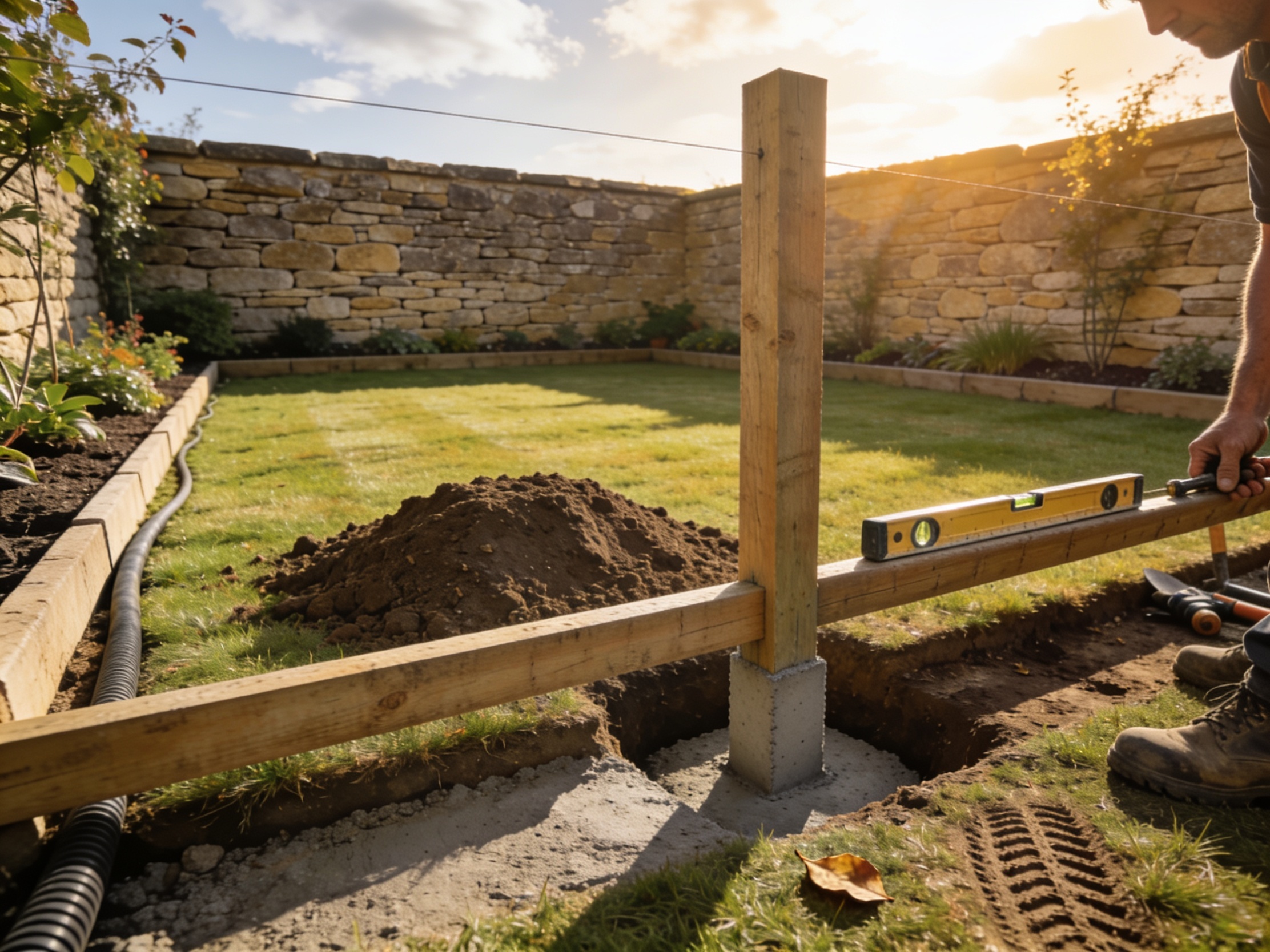
This applies to any firm you use, not just us. It is the handful of things worth understanding before you spend money on fencing.
There is no left-or-right rule in law, whatever you have heard. Your title plan at HM Land Registry shows it: a T mark against the boundary line marks whose it is, and the plan costs a few pounds to download. Worth doing before you spend, because paying for a neighbour’s fence does not make it yours.
Two metres without planning permission in most places, but only ONE metre where your boundary meets a road, which is exactly where most people want screening. Listed building, conservation area or an Article 4 direction removes those rights entirely, so check before you order anything.
Panels outlast posts. Timber rots where post meets ground, so concrete posts remove the problem, properly treated timber set in concrete slows it, and a gravel board keeps the panel itself out of wet soil. Ask what your posts are and how they are set: that decides whether you do this again in six years.