We are approved contractors of the Arboricultural Association, with NPTC and IPAF trained staff, working for homeowners, estates and commercial clients across Herefordshire and the surrounding counties.
From a single garden tree to commercial contracts, every job is carried out to British Standards by trained and accredited staff, with an on-site assessment first.
Trees taken down safely in sections where space is tight, and cleared away afterwards.
Overgrown trees brought back to a safe, balanced shape, or thinned to let light through, to British Standards.
Storm-damaged and dangerous trees made safe quickly.
Stumps ground out below the surface so you can plant or turf straight over it.
Hedge reductions and maintenance that keep a boundary healthy and manageable.
We visit, assess and put our recommendations in writing before anything starts.
We have over thirty years of experience in arboriculture, working for both commercial and domestic customers across Herefordshire and all surrounding counties. We are approved contractors of the Arboricultural Association, our staff are trained to NPTC and IPAF standards, and we are committed to keeping our impact on the environment to a minimum. Every job starts with an on-site assessment and a written quotation.
We work as carefully in your garden as we would in our own. That is not a slogan, it is the habit that decides every small choice on site.
We tell you what the job actually needs, not what is easiest to sell. If the honest answer is to do less, that is the answer you get.
Boots, barrows and waste are our problem, not yours. We leave the place the way we found it, apart from the work itself.
If it is not right, we do not call it finished. The last hour of a job matters as much as the first.
Three stages. The same on every job, whether it is an hour or a fortnight.
Tell us roughly what you are looking at. We come and see it in person, because nothing sensible gets quoted off a description alone.
You will know what is included before anything starts, and the date goes in the diary once you are happy.
The work gets done as agreed, and everything we brought or created leaves with us.
Most jobs are within about half an hour of here. Further afield is not impossible, it just depends on the size of the job.
Ring us, or leave your details and we will get back to you. Tell us roughly what you are looking at and we will take it from there.
01432 860839Or call and speak to us directly.
Sometimes. A Tree Preservation Order can apply to any tree, and inside a conservation area any tree with a trunk over 75mm across is protected automatically. In both cases the council needs notice before work starts, six weeks in a conservation area or five days where the tree is genuinely dangerous. Your council will confirm which applies to your address, usually free of charge.
A reduction makes the whole canopy smaller while keeping the tree’s shape. Thinning removes selected branches from inside the canopy to let light and wind through without changing the outline. If a tree is too big, you want a reduction. If it is casting too much shade, you probably want thinning.
Most deciduous trees are pruned while dormant, roughly November to March. Some species, including cherries and plums, are pruned in summer instead to reduce disease risk. Nesting birds are protected, so work between March and August has to take account of that and may be postponed if an active nest is found. Genuinely dangerous trees are dealt with whenever they are found.
That depends what you want. Chip can be left as mulch for your borders or taken away, trunk sections can be cut into logs and stacked, and good timber can sometimes be milled into boards. Removing it costs money either way, so it is worth agreeing what happens to it before the work starts.
Only if you want to use the ground. Grinding takes the stump below the surface so you can turf or plant over it. If the stump is somewhere out of the way, leaving it is perfectly reasonable. The exception is species that throw up suckers, such as poplar, willow and cherry, where leaving the stump can mean years of shoots appearing.
Fungal brackets on the trunk or base, a sudden lean with lifted soil on the opposite side, large dead limbs, or deep cracks in the stem are all worth a professional opinion. Ivy, some deadwood in a mature canopy, and movement in high wind are usually not problems in themselves.
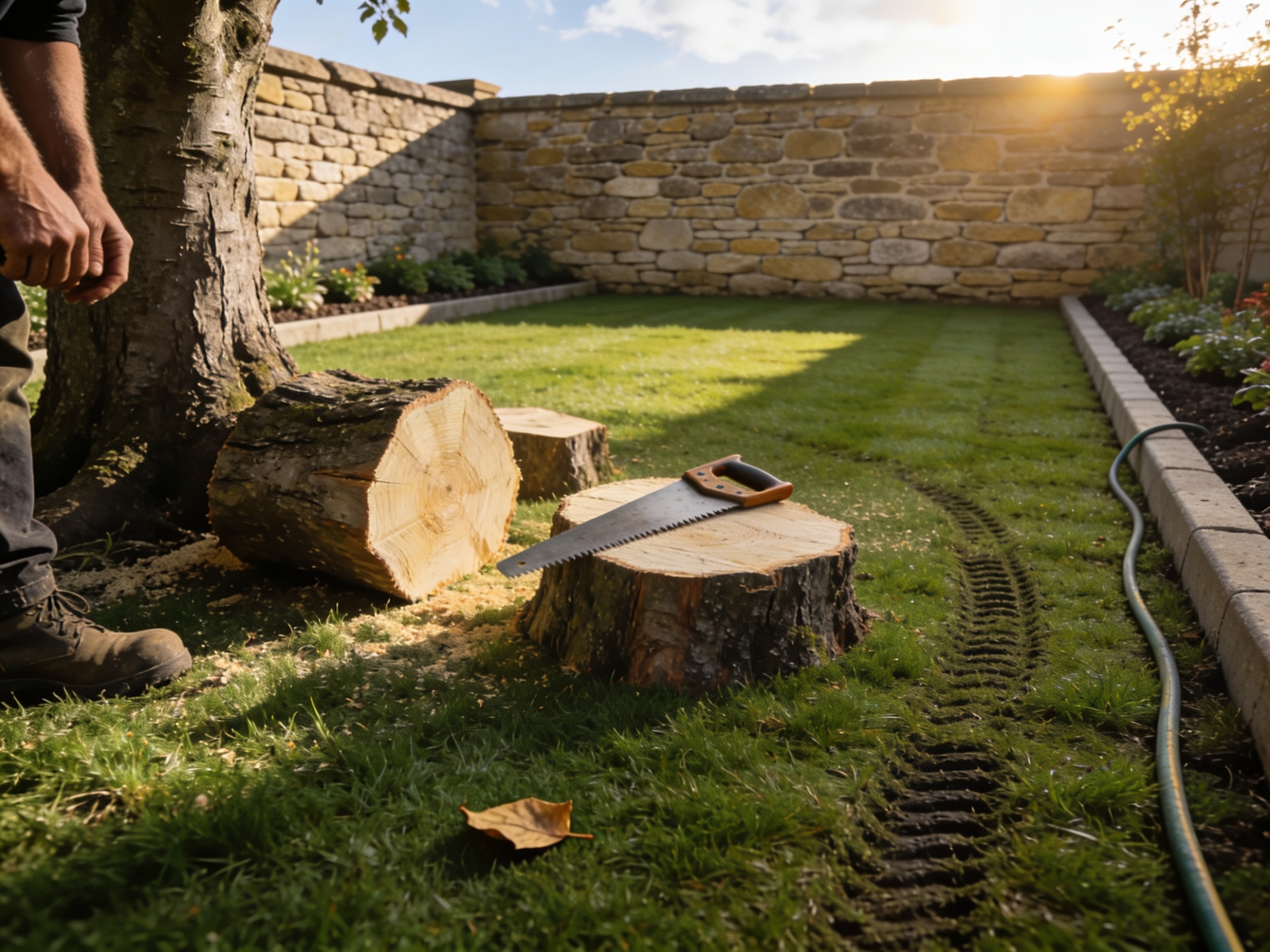
Useful whether you call us or not. These are the parts of tree surgery that cost people money when they are not known in advance.
A Tree Preservation Order can protect any tree, and inside a conservation area any tree with a trunk over 75mm across is protected automatically. Either way the council needs six weeks written notice, or five days if the tree is dangerous. Skipping it is a criminal offence with fines up to £20,000. One free call to your council tells you if it applies to you.
A reduction makes the whole canopy smaller. Thinning lets light through without changing the outline. Lifting clears the lowest branches from a path or roof. Pollarding cuts hard back and commits you to repeating it. Felling takes the tree down. Very different jobs at very different prices, so check which one your quote is actually for.
Nesting birds are protected by law, roughly March to August, so a hedge job may be postponed if a nest is found. Most trees are best pruned dormant in winter; cherries and plums are the exception, cut in summer to avoid disease. If your job is not urgent, ask about the season.